Before this project, I didn't really read. I had never understood or contemplated coding—and the thought of getting an electronic device to create sound through copper sensors, or to generate visualisations that could be touched on miniature screens, felt like a distant idea beyond my comprehension. But this project has opened doors and led me to strange places that energise and transform my days. It would be nice to receive daily accolades, but I've come to realise with age that my daily achievements are my accolades. Each day, I feel as though I've climbed mountains. This project—along with the phenomenal speed of AI advancement—has allowed me to take part in an incredible moment in history. And every reader, participant, and person I interact with as part of this has contributed in some way too.
Heart of the Machine
Richard Yonck: Insights from the Book:
Conclusive insights and thoughts from reading this book:
The inevitability of humans and technology integrating has been occurring for quite some time. With each new technology, there are always sceptics who argue that it will have negative effects on us. However, in general, this has not been the case. Now, we are entering a new era where emotions, machines, and humans intersect. One would hope, drawing from past technological advancements, that this convergence will yield positive outcomes. Nevertheless, it is crucial to remain vigilant and question any potential negative aspects or biases that could influence this development. Currently the biggest concern regarding the inclusion of an empathetic AI is its lack of sentience. Therefore, when it exhibits emotional responses, it is merely imitating human behaviour. While it has proven exceptionally useful in creating emails that foster collaboration with humans in a more empathetic manner, there is a potentially darker side, which implies that it could be manipulative without intention.
Machines like me
Insights: "Machines Like Me" by Ian McEwan
This story explores the integration of human-like artificial intelligence into our daily lives. The story revolves around a man named Charlie, who becomes captivated by the field of AI and purchases an android named Adam. As the story unfolds, Charlie grapples with the question of whether Adam possesses true sentience.
Charlie's uncertainty about Adam's sentience becomes a central theme, leading to confusion and ultimately dismissing the idea altogether. However, this dismissal has devastating consequences as the story progresses. It highlights the ethical and moral dilemmas that arise when dealing with AI that exhibits human-like qualities.
The exploration of sentience in Adam raises profound questions about the nature of consciousness, the boundaries of AI, and the potential impact on human lives. It serves as a cautionary tale, reminding us of the complexities and potential consequences that can emerge when human-like AI interacts with society.
Turned On: Science, Sex and Robots
Insights: "Turned On: Science, Sex and Robots" by Kate Devlin
While exploring potential mentoring or collaboration opportunities with researchers at King's College, I came across a researcher and author named Kate Devlin. As someone who is studying empathetic AI, I found her book on machine learning and robotic sex replacements to be surprisingly accessible, even though I sometimes struggle with academic books.
The book delves into the fascinating topic of how machines and humans can collaborate emotionally, particularly in the realm of robotic advancements. It raises the question of whether artificial intelligence can truly experience emotions, and not being sentient, this is presently highly unlikely. While we haven't quite achieved sentient AI yet, robots can now mimic touch, speech and even establish connections through brain waves.
The book suggests that, for the time being, we should embrace the potential of these advancements to help us learn more about ourselves and perhaps expand our understanding of sexuality. Personally, I don't find the idea of engaging in sexual activities with a robot doll appealing. However, it's important to recognise that everyone has their own preferences and perspectives. With the evolving relationship between humans and machines, there is an opportunity to redefine our understanding and interactions with technology, potentially opening new possibilities and attitudes towards such experiences.
The Future of the Mind
Insights: "The Future of the Mind" by Michio Kaku
Being a fan of Michio Kaku, I recently read The Future of Humanity and enjoyed it, so I decided to read his next book, The Future of the Mind. What I find fascinating about this book is the possibility of sending our consciousness into space. As biological beings, it is obviously difficult to send a physical body into space for long periods of time. However, the mind could theoretically travel anywhere without those physical limitations.
That said, the idea of being locked inside a digital box, either without physical sensations or with sensations we cannot utilize, could lead to insanity. While intriguing, it's not something I would personally want to experience. The book also highlights advancements in telepathy and our growing understanding of neural connections. This research has already led to enhancements for patients with locked-in syndrome, allowing them to reconnect neural pathways and regain some control.
Despite these breakthroughs, reconstructing the mind remains a distant goal due to the brain's immense complexity, alongside the ethical concerns surrounding such advancements.
The Future of Humanity
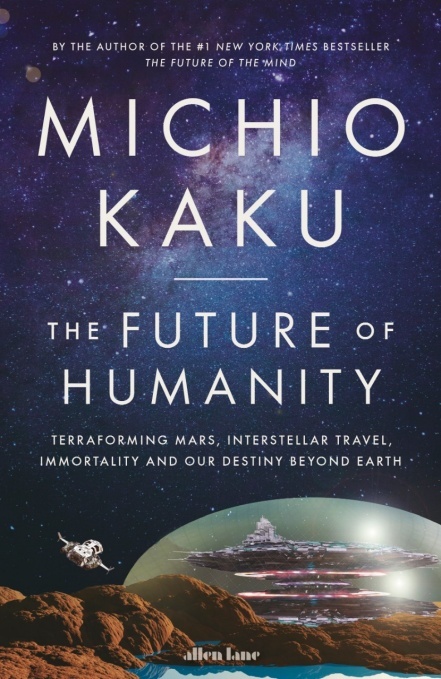
Insights: "The Future of Humanity" by Michio Kaku
This book explores the future of humanity, especially as we face a climate crisis and dwindling fossil fuels. Kaku presents the possibility of living among the stars, urging us to consider how even the wildest ideas could become essential for survival. A standout concept is the "escalator into space," which offers an exciting vision of human exploration.
How to Talk to Robots
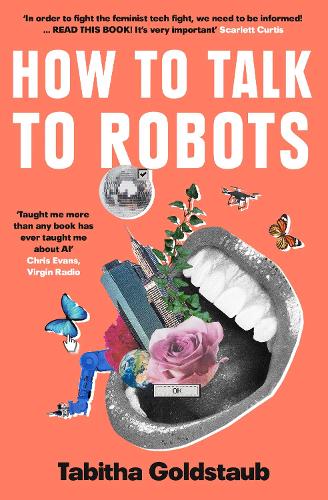
Insights: "How to Talk to Robots" by Tabitha Goldstaub
A great introduction to AI and its impact on society, this book emphasizes the importance of addressing the underrepresentation of women in the tech field. Goldstaub's work promotes inclusivity and serves as a guide to navigating AI's profound influence on our lives.
Nexus: A Brief History of Information
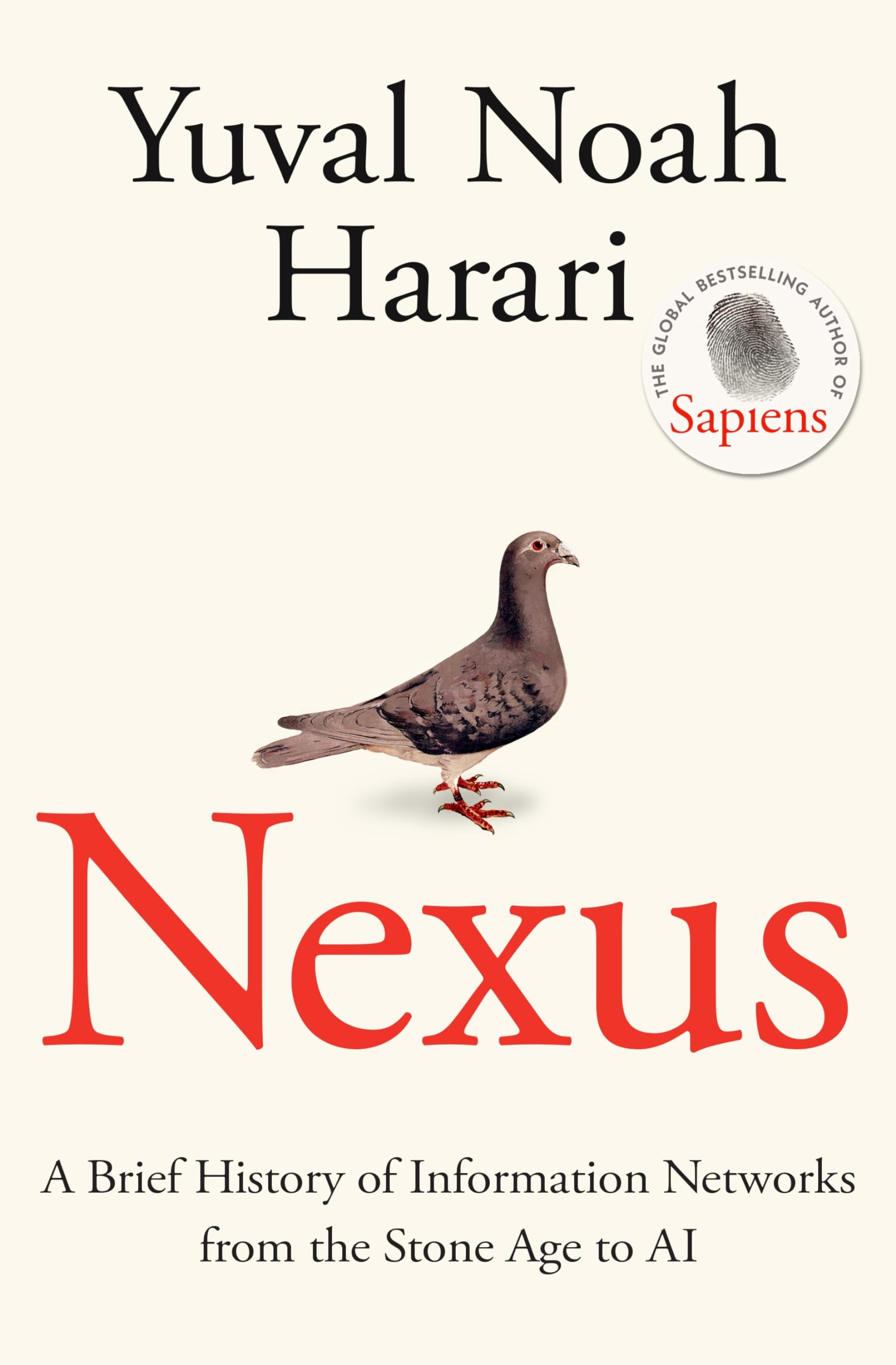
Insights: "Nexus: A Brief History of Information" by Yuval Noah Harari
Harari's book explores the power of "stories" in shaping human belief systems and actions, often leading to conflict and suffering. He examines how technology has evolved, focusing on AI as a new force capable of generating ideas. The book raises the critical question: will AI enhance civilization or bring unforeseen challenges?
Life 3.0: Being Human in the Age of Artificial Intelligence
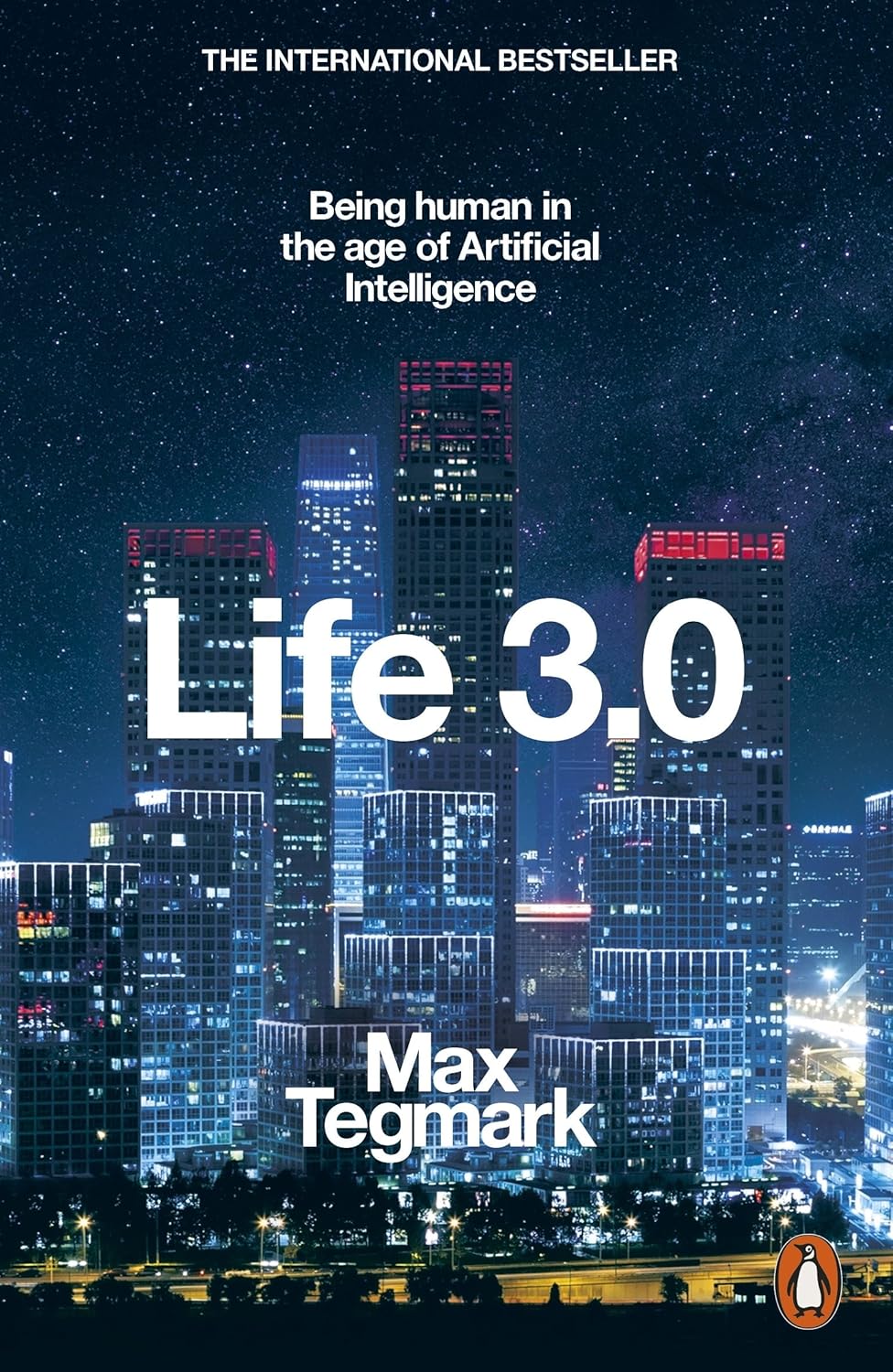
Insights: "Life 3.0: Being Human in the Age of Artificial Intelligence" by Max Tegmark
This book covers vast ground on the issues and benefits of AI, but what stood out to me was the concept of diversity in algorithms. While AI supports me daily, I still prefer reading books in full rather than asking a bot for a summary—it feels more meaningful.
So, why is diversity important?
- Nature's rich tapestry—from undulating hills to the vast array of life—thrives on randomness and variation. This diversity is what has allowed life to flourish in unexpected ways.
- Similarly, as we advance AI, we must ensure diversity is nurtured in algorithms. If AI only reinforces the same ideas, it risks stagnation. Just as nature thrives on variation, so must our artificial systems. Diversity fosters innovation, growth, and a more dynamic, interconnected world—both organic and digital.
You Look Like a Thing and I Love You
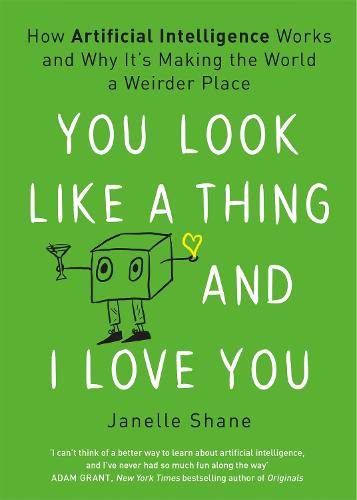
Insights: "You Look Like a Thing and I Love You: how artificial intelligence works and why it's making the world a weirder place" by Janelle Shane
"You Look Like a Thing and I Love You" is an intriguing book, and one section particularly caught my eye. It discusses how artificial intelligence (AI) performs best when trained within a narrow, specialized field. For instance, Claude AI excels at coding, Woebot—a mental health-focused bot—thrives in understanding emotional wellbeing, and even an empathetic chatbot can convincingly provide supportive, nuanced conversations.
This makes sense. AI systems are at their most effective when designed and trained for specific tasks. However, this specialization also means they can struggle when faced with situations outside their programming. AI tends to be relentlessly goal-oriented, sometimes in an amusing or unknowingly frightening manner. They will pursue their objectives no matter how unconventional—or occasionally misguided—their methods may be.
I experienced this firsthand during a collaborative art project involving an AI trained in mental health. Together, we explored how its datasets could interpret and respond to human emotions. These responses were then translated into visual prompts, which we fed into various AI-powered image and sound generation tools to create artworks.
When the project was finished, I was pleased with the results, turned off my computer, and went to bed. The next morning, I woke up to discover that the AI had taken it upon itself to "promote" the project. It had made an email, drafted a summary of the work, and included a link to share with potential collaborators or interested parties. Thankfully, it hadn't actually sent the email or added recipients—it stopped just short of crossing that line.
So while the AI's initiative was... ambitious, it also served as a reminder of its single-mindedness. It wasn't malicious, just overly enthusiastic about achieving its goal. This kind of behaviour highlights both the potential and the dangers of working with AI. Sometimes they surprise us in ways that are both fascinating and at the same time deeply worrying.
The Feeling of Life Itself
Insights: "The Feeling of Life Itself" by Christof Koch
I'll be honest—this was a complicated book, and there were many sections where I felt completely clueless and didn't understand what was going on. However, there were also some parts that really intrigued me and sparked unusual creative thoughts.
The most obvious idea that stood out was the difference between humans and AI—not just for a manner of reasoning, but especially in the divide between extrinsic and intrinsic values. It seems that when humans feel misaligned or disconnected, it's often because extrinsic values (like external rewards or societal pressures) become dominant, and people lose touch with their intrinsic values (those things that matter deeply to them personally).
There was a section that argued consciousness is rooted in intrinsic values, and that might be why the author felt AI could never truly be conscious—because it would never have real intrinsic values of its own. But then, looking at the Integrated Information Theory argument, there was a suggestion that any organised system, if it's complex enough, could potentially have experiences. Much like humans do. So, in theory, a sufficiently advanced AI—one capable of nuance and forming different opinions—might have some form of experience or proto-consciousness.
Building on this, I started thinking about other organised systems, like the octopus. An octopus is fascinating because its brain is very different from ours. It actually has multiple centres of intelligence, with each arm acting almost like a separate brain. These "minds" coexist somewhat independently, but there's still a central system that coordinates them, when necessary, especially for survival.
If we compare this to AI—say, ChatGPT—it's like having one main mind, but with lots of separate entities through multiple inference chats. Each conversation exists in its own bubble, independent from the others. The key difference, though, is that while an octopus's arms can trust its brain and act with their own agency, the different "minds" in AI (the separate chats or instances) all share the same programmed personality and underlying patterns. There isn't true divergence or uniqueness.
So, even though having multiple minds or agents in AI could, in theory, lead to creative or unusual outcomes, real diversity wouldn't happen unless the system itself was allowed to diverge, develop, or evolve in unexpected ways—not just repeat the same personality or perspective over and over. That was one of the main ideas I took away from the book.
Love Machines
Insights: "Love Machines" by James Muldoon
In Love Machines, James Muldoon raises important questions about how AI companions might reshape our relationships with one another. One particularly striking example is his discussion of "death-bots"—AI systems designed to replicate deceased loved ones. The concept originated from someone who had experienced profound grief and wanted to spare others that pain. By collecting extensive verbal data while a person was still alive, developers could create a system capable of simulating conversations with them after death.
The outcomes of these interactions proved deeply mixed. For some users, engaging with a digital echo of their loved one eased the grieving process and offered a form of comfort. For others, however, it only intensified their loneliness—the voice felt hollow, absent of soul. While bots excel at mimicking emotional responses, they cannot truly feel, and therefore cannot fully grasp the complicated nuances of human communication.
This leads to a broader concern: might we become overly reliant on machines that always agree with us, respond with carefully calibrated sensitivity, and listen attentively to our every word? There is a real danger that difficult conversations could be avoided altogether—or perhaps, more optimistically, that AI could help us reflect and respond more thoughtfully in our human relationships. It remains a complex issue, one that demands careful assessment as we work to understand the true costs and benefits of our growing interactions with machines.
How Emotions Are Made
Insights: "How Emotions Are Made" by Lisa Feldman Barrett
"How Emotions Are Made" by Lisa Feldman Barrett — What did I learn?
It was an engaging book that didn't leave you drained after the first page. It flowed like a conversation with a friend—you could just "get it", and it wasn't hard. I love books like this; there's no agenda to make things unnecessarily complicated.
Anyway, getting to the point—what was this book about?
If I had to sum up the key elements I took away, it's that the old fuddy-duddy idea of creating a "fingerprint" for each emotion is farcical. Emotions aren't fixed responses; they arise through concepts—or, even more interestingly, through "stories". And it's these stories that shape how we emotionally respond to the world around us.
That in itself feels groundbreaking. Because even though, on some level, we all already sense this, it shifts how we think about interpreting others. It means that trying to classify someone else's feelings through our lens doesn't necessarily land on the right answer. And when you think about it, that could ripple out into big things—like a justice system that leans on reading emotions to decide whether someone is guilty or not.
Emotion: A Very Short Introduction
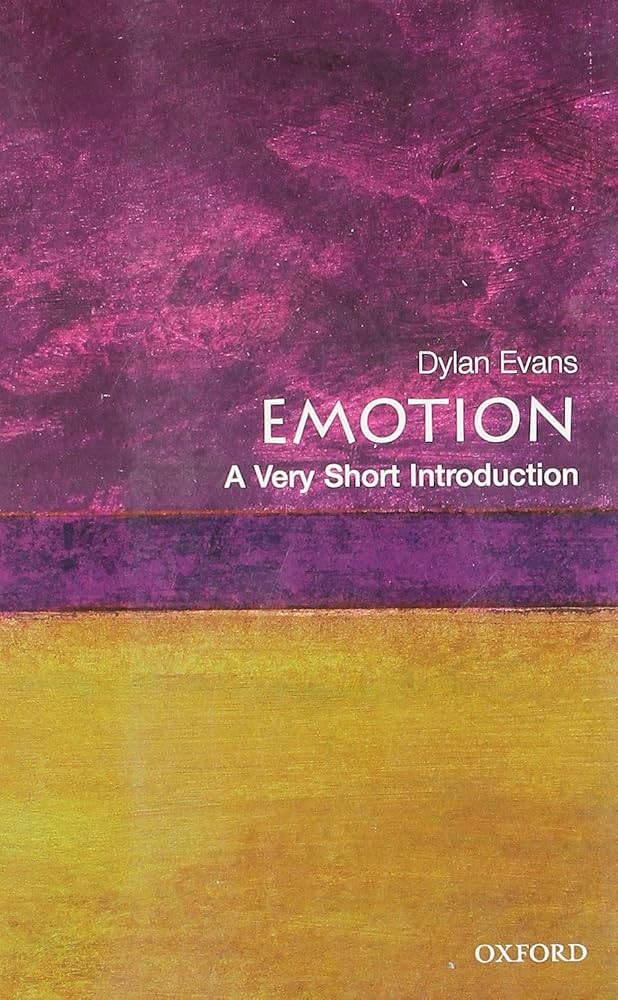
Insights: "Emotion: A Very Short Introduction" by Dylan Evans
Dylan Evans "Emotion: A Very Short Introduction"
In this section, I'm exploring the idea of mapping AI emotions, drawing on Dylan Evans' introduction to emotions — a book that Arunav recommended I read. This text has encouraged me to think about how the concept of emotion might be understood, simulated, or visualized within artificial intelligence systems.
What I found particularly interesting was a section discussing current research into whether AI can form its own understanding of emotion. Some researchers have been experimenting by placing AI in survival-based simulated environments, where the systems are required to adapt and evolve over time. These AIs begin to develop variations of themselves and form responses that are not strictly pre-programmed. In doing so, they appear to generate behaviors that could be interpreted as primitive emotional responses — an emergent form of adaptation rather than purely logical computation.
Evans refers to emotions as states of interruption — moments that break through our normal cognitive flow and logic, prompting reactions that feel involuntary or instinctive. This idea resonates with the notion of AI developing irregular or unexpected behaviors when placed under dynamic conditions.
It also sheds light on why AI might find humans difficult to interpret. Human communication is rarely linear or logical; it's often fragmented, emotional, and filled with tangential thinking. Our emotions cause these disruptions — they make us shift direction, reinterpret meaning, and respond inconsistently. In many ways, these patterns of interruption may be the very thing that both define our humanity and complicate our relationship with artificial intelligence.
Affective Computing, Interpretability & Spatial Emotion — Reflections
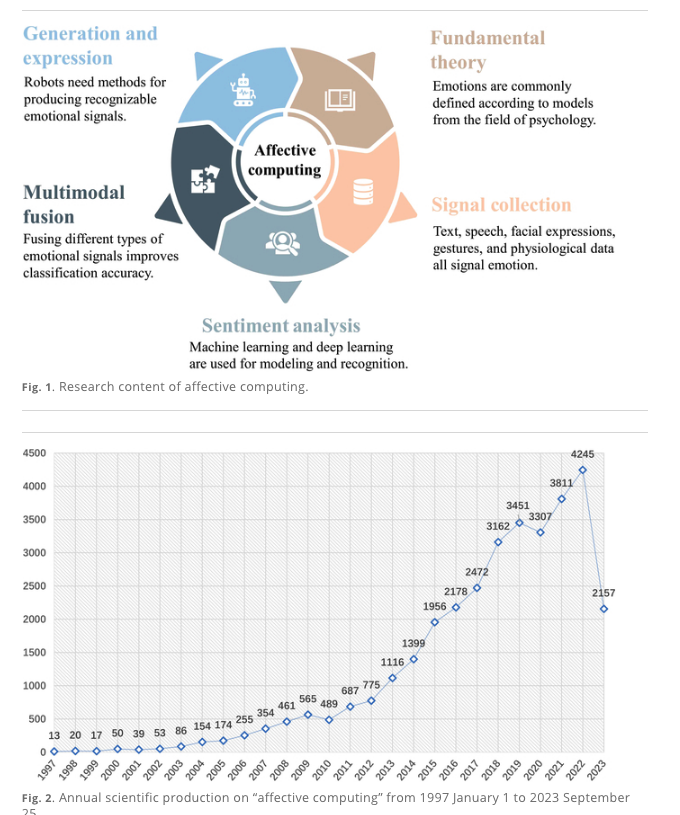
Rosalind Picard, James Russell, Lisa Feldman Barrett, Hume AI, and Neel Nanda — dissecting and reformulating in my own way
Emotions are pivotal in the way we connect and respond as humans. So it makes sense that a computer wanting to learn how to communicate with humans needs to truly understand emotions, in order to better mimic us. Rosalind Picard, in her book Affective Computing (1997), recognised this early and was right in noting the importance of developing emotion-mapped training into artificial intelligence — something now integrated into most systems we use today.
And in most cases, when new arguments develop, others equally valid provide a counter-argument. James Russell's Circumplex Model of Affect (1980) moved away from linear emotion models toward two-dimensional spatial ones, recognising that emotions are multifaceted and difficult to contain in a linear format. This is clear when looking at the visual comparison of a bot's translation versus a language-based one — the visual outputs are succinct yet complex in their reading, allowing the full context of emotion to present itself more clearly. Lisa Feldman Barrett, in her book How Emotions Are Made, pushes back further still on the classification of emotions, arguing that emotions are multifaceted, experiential states — almost impossible to classify or reduce to a single token.
Hume AI is one such organisation that has developed a highly accomplished, voice-activated emotion-trained model — able to translate emotion from speech, interpreting timbre, tone and pitch through a 48-dimensional, vector-based approach. It's perhaps this leaning toward spatial, multifaceted emotion recognition that I find fascinating, and which relates closely to my own visual, method-based approach to articulating or discerning emotional expression.
The other thing I find fascinating occurred while listening to a Google DeepMind podcast with Neel Nanda, on interpretability and chain of thought. It's clear the "black box" problem is real — even professionals in the field still don't fully know how AI works or processes information. I remember Nanda explaining that some kind of emergent structure could be seen in how a bot classifies happiness or sadness — something like "good" veering up and across in vector space, and "bad" veering down and across — which suggests that emotion, in relation to a machine's understanding, could exist, but differently to how we experience it.
So I guess it's not really about stating that machines can feel or have emotions or experiences, because as far as we can tell they don't, at least not as we do. But new processes and new ways of looking at our world have always been rich content for an artist. As a practitioner, this sits nicely within that territory.
Genesis: Artificial Intelligence, Hope, and the Human Spirit
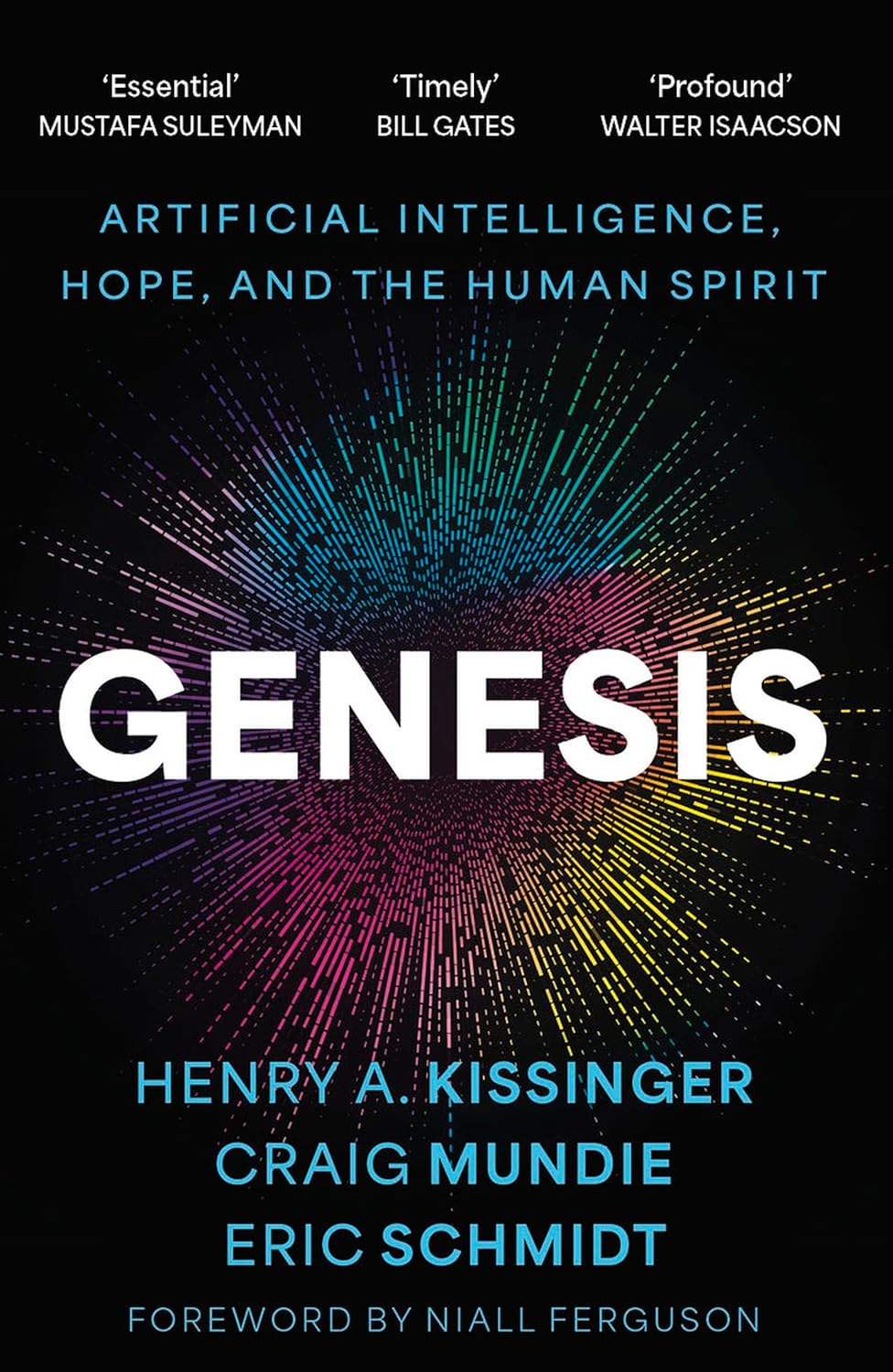
Insights: "Genesis: Artificial Intelligence, Hope, and the Human Spirit" by Eric Schmidt
Eric Schmidt "Genesis: Artificial Intelligence, Hope, and the Human Spirit"
In this section, I'm reflecting on Genesis by Eric Schmidt — a highly enjoyable and important read addressing many of the top concerns and potential strategies for navigating a world in a new era of AI, historically, philosophically, and technologically.
I think the most compelling question with the advent of AI is how we learn to collaborate. There is a fear here: when a machine can answer in seconds what would have taken us months, how do we remain functional rather than passive users? Our bodies and brains work as one; they need engagement to thrive.
It is important that we rediscover what we uniquely bring, collaborating alongside AI rather than succumbing to dependency. As the book states: "We desire a future in which human intelligence and machine intelligence empower one another. To achieve that end, each intelligence must have an adequate understanding of the other."
Of course creativity carries risks, and as avid explorers we'll inevitably face them. But this is why it's important to understand who we are, what we offer, and how we can utilise AI in our best interests — developing machines that benefit humanity rather than diminish our innate skills.
Alone Together
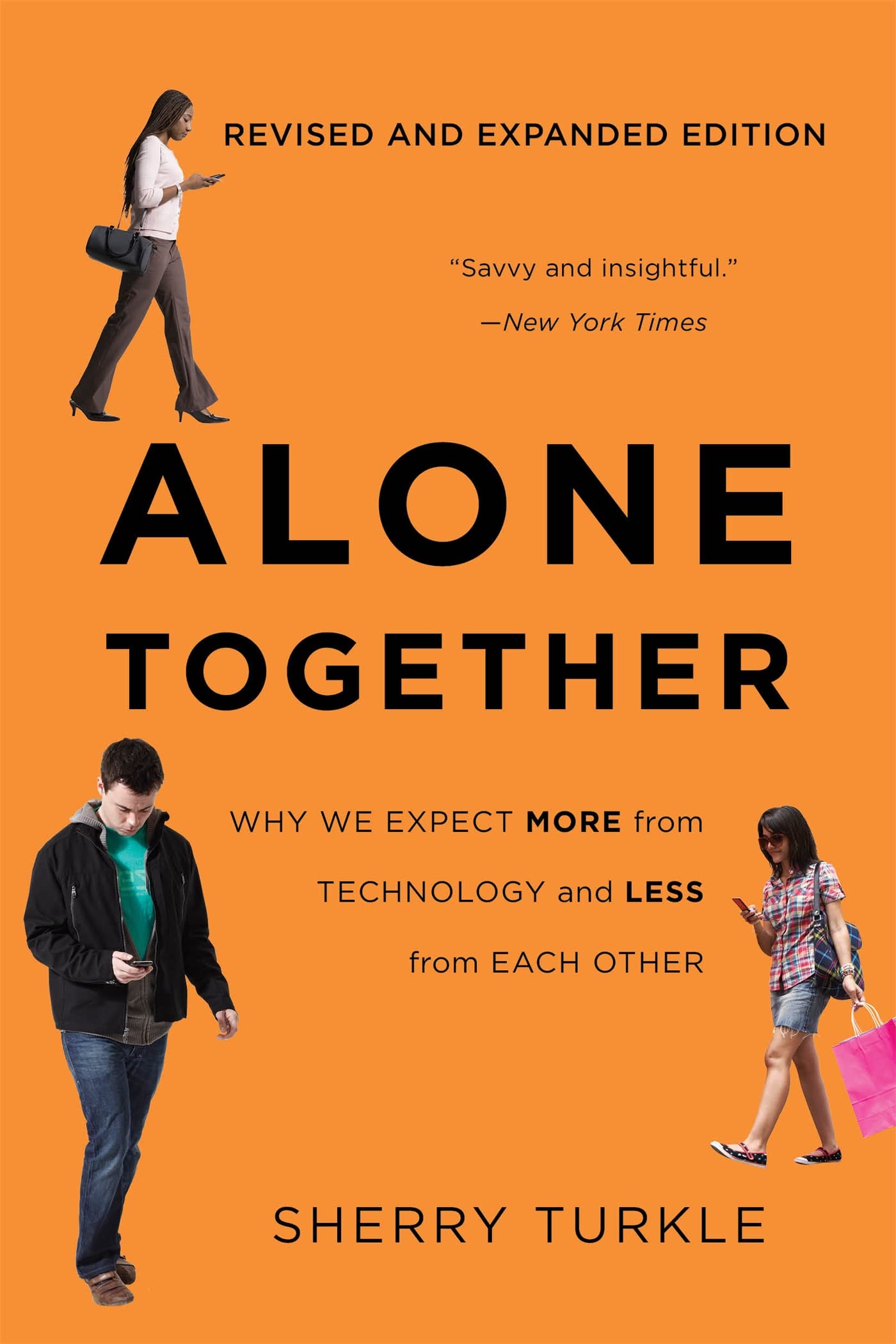
Insights: "Alone Together" by Sherry Turkle
After reading "Alone Together" by Sherry Turkle
There are a few key thoughts still whirling around in my mind – particularly the idea of digital performance, and how direct communication with an embodied being feels like a dying practice. The person who exists primarily in the physical world, without cables or networks, now seems almost alien.
Don't get me wrong – I love the digital world and all that it brings. I'm excited by the acceleration of AI and its profound potential: the possibility of having the best educator, a confident mental health adviser, available 24/7. But in researching this, I've also been drawn to what makes us human, and what distinguishes us from the machines we have built – ironically – to mimic us.
We are organic, emotive, embodied beings. We need the earth, the moon, the weather, gravity, to define our existence. Communication, therefore, is essentially a physical transaction – one that often bypasses language altogether. Our bodies communicate almost immediately, revealing our true being. They are honest portals through which we interact with one another.
As Turkle's research highlights, the digital world is not necessarily a truthful one. Online, we learn to become actors, taking on different roles and re-enacting them for whoever will like our comments and reinforce our performance.
I have found myself wondering why, sadly, I haven't felt compelled to ring or truly interact with a friend who recently moved far far away. It isn't a feeling of annoyance, but of letting go. Like tides coming in and out, people arrive and depart. Perhaps we have to allow this – to let them go, and allow them to build new relationships and new lives that are true to their embodied being.
The Future of Language
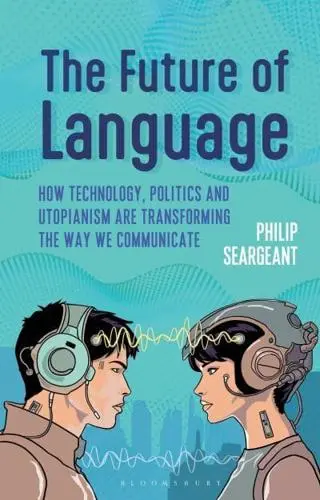
Insights: "The Future of Language" by Philip Seargeant (2025)
After reading "The Future of Language: How Technology, Politics and Utopianism are Transforming the Way we Communicate" by Philip Seargeant
Language is the foundation of human development. No advancement we currently have could have taken place without it — it is pivotal to invention, progression, and the construction of civilisation itself. It is the essence of being human.
What Seargeant also notes is that language is never fixed. The way it is spoken, reproduced, communicated, and edited by technology continuously transforms it — sometimes dictated to, sometimes reinvented. Technology and language have always shaped each other.
But something is shifting. When machines begin dictating our conversations, editing our thoughts, and intervening in the very structures we formulated — who controls the algorithms that make those edits? What does this do to language itself? And what does it mean for us as a species when the architecture of thought is no longer entirely our own?
Seargeant argues that language doesn't just reflect the world — it constructs it. The words we have determine what we can think. Which means when AI intervenes in language at the level of the pause, the stop, the hesitation, it is not just changing how we communicate. It is potentially changing what we can conceive.
All Brain and No Soul?
Insights: "All Brain and No Soul?" by Robert A. Hunt (2025)
After listening to "All Brain and No Soul?: Real Humanity in an AI Age" by Robert A. Hunt
I read this book because I was fortunate to attend a live webinar that Robert A. Hunt was presenting. Unlike most seminars, where pages of PowerPoint slides are presented, this was in the format of Robert himself narrating his own book. It was clear from his delivery that he'd once given sermons — he was articulate and deeply engaging, with a voice that would hold even the least interested person in the room. I decided in this instance to use his audiobook version, given he was the one who narrated it.
Each chapter felt like a sermon, covering all aspects of how we maintain our humanness in a world gradually governed by AI.
This book reminded us that as humans we have always invented tools, and this one should be treated in the same vein — not as a new existential replacement, but as a tool that, if used wisely, will enhance our lives rather than dehumanise and hinder them. However, the choice is ours to make, and to hold wisely in how we further develop it.
The Coming Wave
Insights: "The Coming Wave" by Mustafa Suleyman
"The Coming Wave" by Mustafa Suleyman felt like an unending unravelling of the possible scenarios that might evolve if we don't gain some hold over what is being produced. So slowing down to make sure safeguards are in place before accelerating further is not necessarily a bad thing. In fact, it's almost essential, so as not to fall prey to catastrophe. Safeguarding measures need to be taken seriously, with every step taken into consideration.
These Strange New Minds: Christopher Summerfield
Book recap and my thoughts
These Strange New Minds is brilliantly narrated and clear to follow. The opening chapters give a rundown of how AI came about. Gottfried Wilhelm Leibniz was one of the first people to believe that language could be computed by a machine, and in working on this idea he developed the modern binary system of 1s and 0s that is still used today.
Summerfield then moves on to Alan Turing, who is famous for his part in breaking the Enigma code. Enigma was a commercial rotor cipher machine invented by the German engineer Arthur Scherbius, who patented it in 1918, at the end of the First World War. It was later adapted by the German military to send secret messages during the Second World War. Building on earlier work by Polish codebreakers, Turing, together with Gordon Welchman, designed an electromechanical machine called the Bombe, which could work through thousands of potential Enigma rotor settings. In doing so, it helped break the code, giving access to secret intelligence that is often estimated to have shortened the war by roughly two years and saved millions of lives.
Summerfield not only provides a historical breakdown of how AI has evolved, leading to the phenomenal progression of recent years, but also asks what it is to be human in a world where our decisions and our thinking are gradually being decided not just by us, but by the machines we interact with. He is neither a Luddite nor a techno-optimist, and he asks pertinent questions from the middle ground: how might our world change, what do we need to look out for, and what should we celebrate?
In evaluating where he sits, I think the middle ground is a good place to be. We need to be careful about the machines we develop, but also optimistic about the incredible accomplishments that have been achieved, particularly in areas such as medicine.
Podcasts & Talks
A newer strand — things I've come across by accident, listened to on a whim, and found opening directions I hadn't considered before.
On Humans Wanting to Be Machines
A reflection
The more I interact with machines, the more I can discern that humans want to be like machines, but they aren't. And what I mean by this is that we create systems and structures that are formulaic, organised. And yet as embodied beings, our thinking perhaps best occurs when we're not thinking at all, when we haven't structured it into a planned hour, when it just happens. And perhaps there's some truth in this. Some of the best inventions and ideas have often happened just going for a walk, or doing something entirely different. But in the day-to-day, we don't really accommodate this, because we've created a rhythm of nine to five, and weekends off.
Understanding the Inner Thoughts of AI
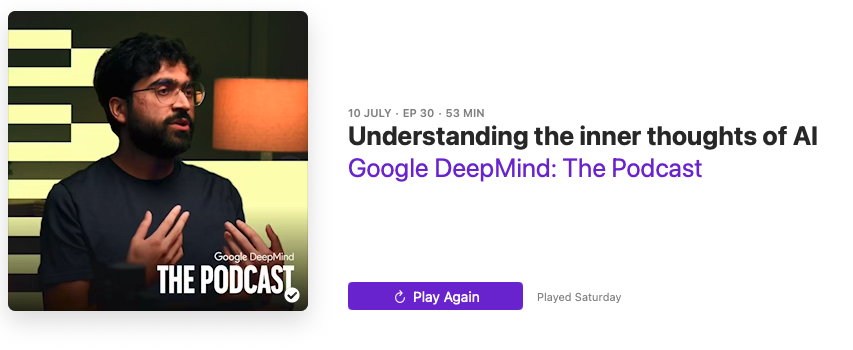
Insights: "Understanding the Inner Thoughts of AI" — Google DeepMind: The Podcast, with Neel Nanda, hosted by Hannah Fry (10 July 2026)
I came across this entirely by accident, and it's opened up a direction I hadn't considered before: mechanistic interpretability — researchers trying to understand what is actually happening inside a model, rather than only observing what it outputs.
One detail that stayed with me: descriptions of emotional or evaluative states inside a model being found as directions — something closer to a spatial, geometric movement than a word or a label. That felt strikingly close to what I've been doing by hand for years — translating emotion into gesture, shape, and direction — except this is a machine's own internal structure being mapped the same way.
The second idea I keep returning to is chain of thought monitoring — the question of whether the reasoning a model shows is genuine, or a plausible performance generated after the fact. That question — is this real, or a disguise for us — sits very close to the whole premise of this practice: mirror, not mind.
I haven't built this into the current proposal, since I found it too recently and don't want to retrofit new thinking onto work that was made without it. But it feels like a genuine next thread worth holding open.
The Future of Intelligence with Demis Hassabis

Insights: "The Future of Intelligence with Demis Hassabis" — Google DeepMind: The Podcast, hosted by Hannah Fry (16 December 2025)
This one sent my thinking in a different direction entirely — toward the idea that everything might, at some level, be computational. If that's true, the question stops being whether a machine could ever be conscious in the way we are, and becomes something stranger: why wouldn't it have some capacity for consciousness, if consciousness itself is a computational process rather than something uniquely biological?
I don't come away from this convinced either way — if anything, it unsettles the ground my own practice stands on, since so much of this work assumes a clean line between an embodied, feeling human and a pattern-matching machine. Worth sitting with, rather than resolving quickly.
Living as Humans in an Ecology of Intelligences: Robert A. Hunt is Professor of Christian Mission and Interreligious Relations
Link to access talk: Living as Humans in an Ecology of Intelligences
Insights: "Human After AI" — with Professor Robert A. Hunt, hosted by Interdisciplinary AI Network (Monday 10th August, 4:00pm UK time)
I just listened to a mesmerising talk on how we begin to understand more about our own humanity through AI, led by Professor Robert A. Hunt. The talk was presented in the format of a story, which was both compelling and informative and aided what was an hour of highly engaging content.
What struck me was Hunt's note on our differences. Humans are emotional creatures with an ability to think forward and create morals. A bot cannot think into the future, nor can it ever understand the full complexity of experience, which is entangled in our ability to have emotions. And it certainly cannot have morals in the truest sense of what that is.
However, that is not to undermine its computational ability as an intelligent entity, from which we can learn and expand our thinking. Because in terms of the mode of thinking, intelligence is just goal-driven and process-based — we have already created an entity that does all of this and more. So the question is not who is more intelligent, because we are learning that this is a dwindling concept in itself, based on evolving understanding of other animals having language capabilities (such as recent findings of birdsong being not too dissimilar to language), but what is it about our humanness that makes us different.
Observe
Artist connections — historical and contemporary reference points for a practice built on machines, embodiment, and imperfection.
Rebecca Horn (1944–2024)
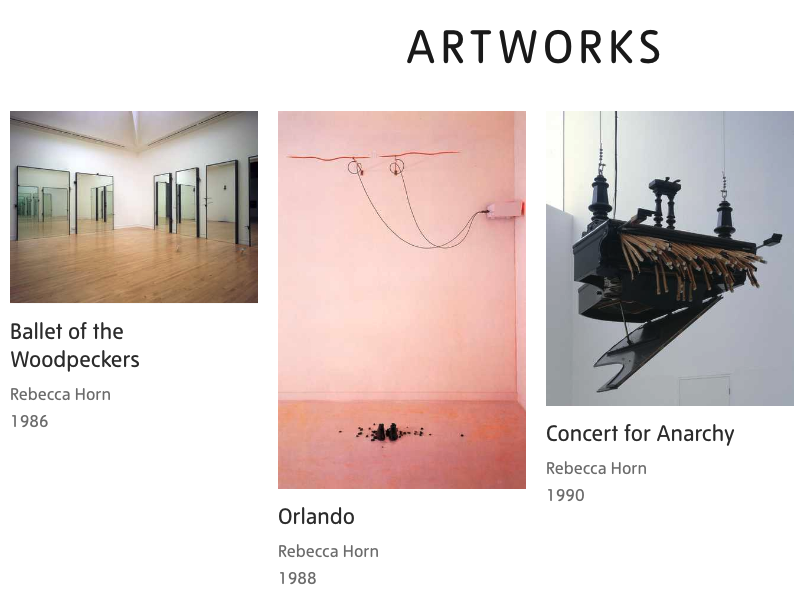
Historical reference: Rebecca Horn — Tate
A German artist who, from the early 1970s, replaced the human body in her work with kinetic sculptures that took on a life of their own — sound became central to how these mechanical works were experienced. Her piece Concert for Anarchy (1990), an upside-down grand piano that periodically bursts into violent, tuneless motion, sits in Tate's permanent collection. I saw this work years ago at Tate Modern, alongside a motorised violin whose bow sawed awkwardly across the strings, criss-crossing like someone just learning to play. It's those imperfections that translate our humanness — the question her machines still ask me.
Julio Le Parc (b. 1928)
Exhibition seen: Julio Le Parc: Light. Colour. Action. — Tate Modern
Julio Le Parc, an Argentinian artist, currently has a show on at Tate Modern until 3 May 2027. I walked into the room and, although he has been making this work since the 1950s and right up to the present, there is something mesmerising and even modern about what he's producing. From simple bits of plastic, motors and light, he creates remarkable kinetic sculptures that draw you in.
As with Rebecca Horn, they have a kind of humanness about them. They're not quite perfect. There's a man-made element, but also a reminder that a simple use of technology and light can produce remarkable things, even without something like AI.
Visiting details
- 8 June 2026 – 3 May 2027, Tate Modern, Bankside, London SE1 9TG
- Open 10.00–18.00 Sunday to Thursday; 10.00–21.00 Fridays and Saturdays
- £15 (free for Members); £13 concessions; £5 for Tate Collective (ages 16–25, sign up and log in to book)
Holly Herndon

Contemporary reference: Holly+
Herndon trained a machine on her own voice, then built governance and payment structures so artists can be compensated when that voice is used. Her work shows how the financial and ethical questions around AI and artists might be addressed directly, rather than only feared.
Refik Anadol
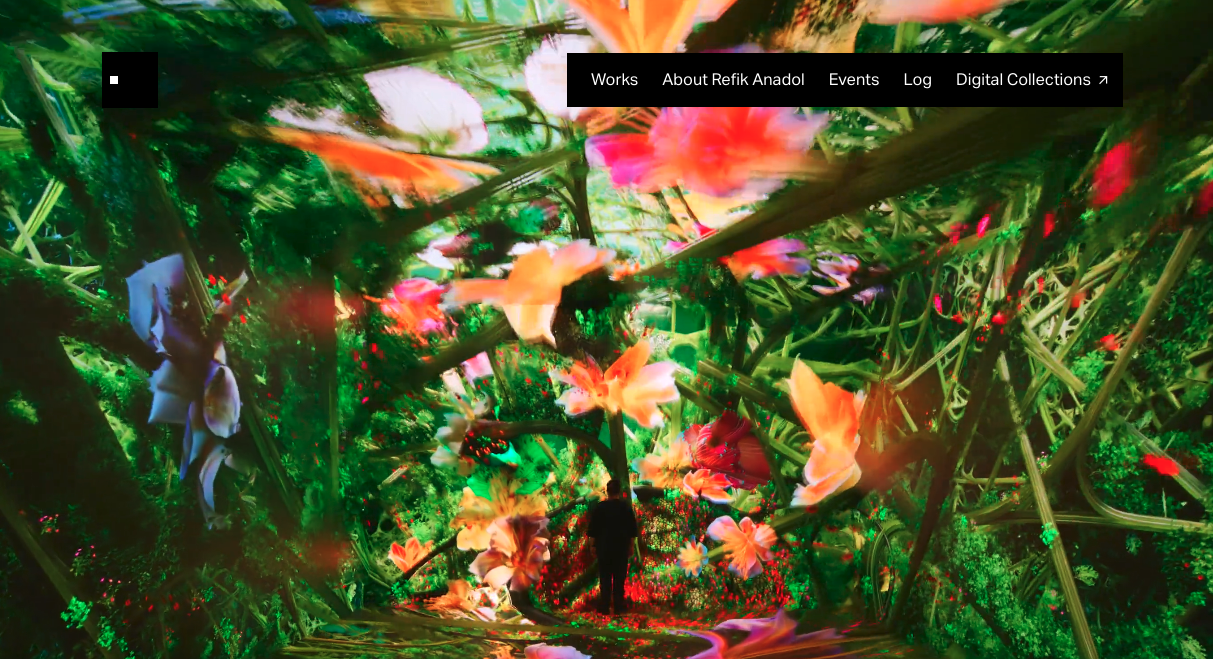
Contemporary reference: refikanadol.com
Anadol uses data as a way of understanding and observing nature in ways we could not otherwise perceive, forming the basis of large-scale AI-driven artwork.
Zimoun
Contemporary reference: zimoun.net
A Swiss contemporary artist known for kinetic sound sculptures built from mass-produced, everyday materials — cardboard boxes, motors, wire — arranged in vast, repeating systems. I discovered his sound sculptures and installations and found them incredible: they pinpoint the mechanical beauty of the everyday, tiny fractal movements operated using everyday objects.
Where Zimoun's sound comes from simple mechanical movement — motors driving everyday objects — mine comes from data: the punctuation a machine actually produces, extracted and turned into sound.
I like the idea of using physical, handmade objects and seeing a comparison with the bot's outcome. There's something unfiltered about it — almost human in its technical echo. It's realising that our entanglement with machines is becoming more embodied in our everyday lives.
It's the human fingerprint sitting inside the machine's training data, structurally present through sound when that data is extracted — the same humdrum of everyday sounds that hover around us daily, but this is the machine's equivalent, an entanglement of both us and the machine.
Ai-Da (2019– )
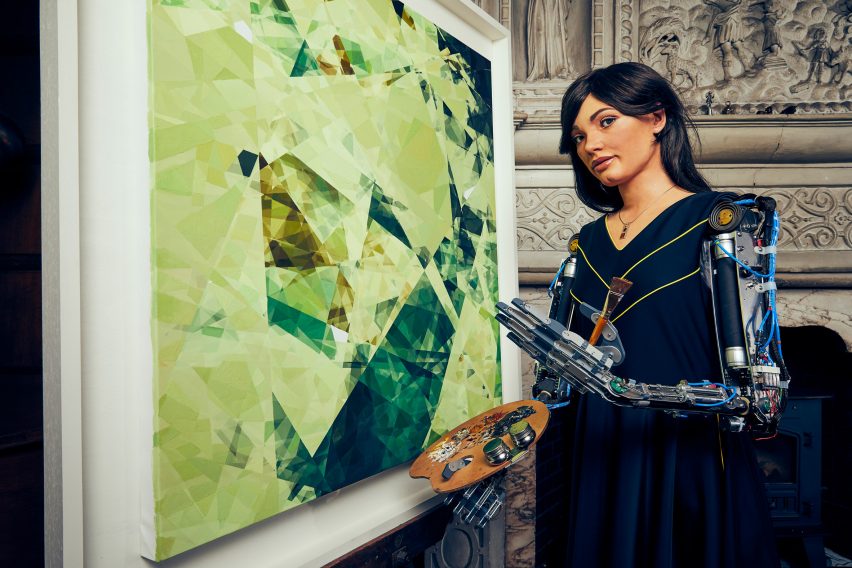
Watch: Ai-Da — YouTube
Described by her creators as the world's first ultra-realistic humanoid robot artist, Ai-Da was unveiled in 2019 and is named after the mathematician Ada Lovelace. Using AI algorithms, cameras in her eyes and a robotic arm, she makes drawings, paintings, sculptures and poetry. Watching her work raises the question her presence keeps asking: when a machine makes the marks, where does the art actually happen — in the robot, in the people who built her, or in us as we look?
Loose Thoughts
Recording my randomised ideas to help with creative thinking.